Family owned in North Pinellas County since 1990 Seven days a week, 9:00 AM to 5:00 PM
Jack Coniam, Inc. Lawn & Landscaping
Service

Tree trimming

Tree trimming here means two things: lifting the low limbs so there is room to walk and drive underneath, and pulling growth back off the roof, the gutters, the driveway and the walkways. Both are much easier to deal with before storm season than during it.

Booked as
On its own, or added to a scheduled maintenance visit
The two jobs
Lifting low limbs, and clearing growth off the house and the paving
Best time of year
Before storm season, which starts on June 1
Size of tree
Still to be confirmed. Tell us the tree when you call
01 What is covered

What this service covers, and where it stops

The service on the list is tree trimming. Where that work stops has still to be confirmed, so this page states no size limit in either direction. Tell us the tree when you call and we will tell you whether it is work we take on.

What the page can tell you now is what the work itself is. Trimming is the shaping and clearance work on a tree you already have: taking the lowest limbs off so there is headroom under the canopy, cutting growth back where it has reached the building or the paving, and taking out dead and broken wood that is going to come down anyway.

It is not the same conversation as taking a tree out, and it is not the same conversation as heavy work high in a mature canopy. Those depend on the tree, and they are worth asking about directly.

So tell us the tree when you call. Where it is, roughly how tall, whether it is over the house, and what is bothering you about it. That is enough for us to tell you whether it is our work.

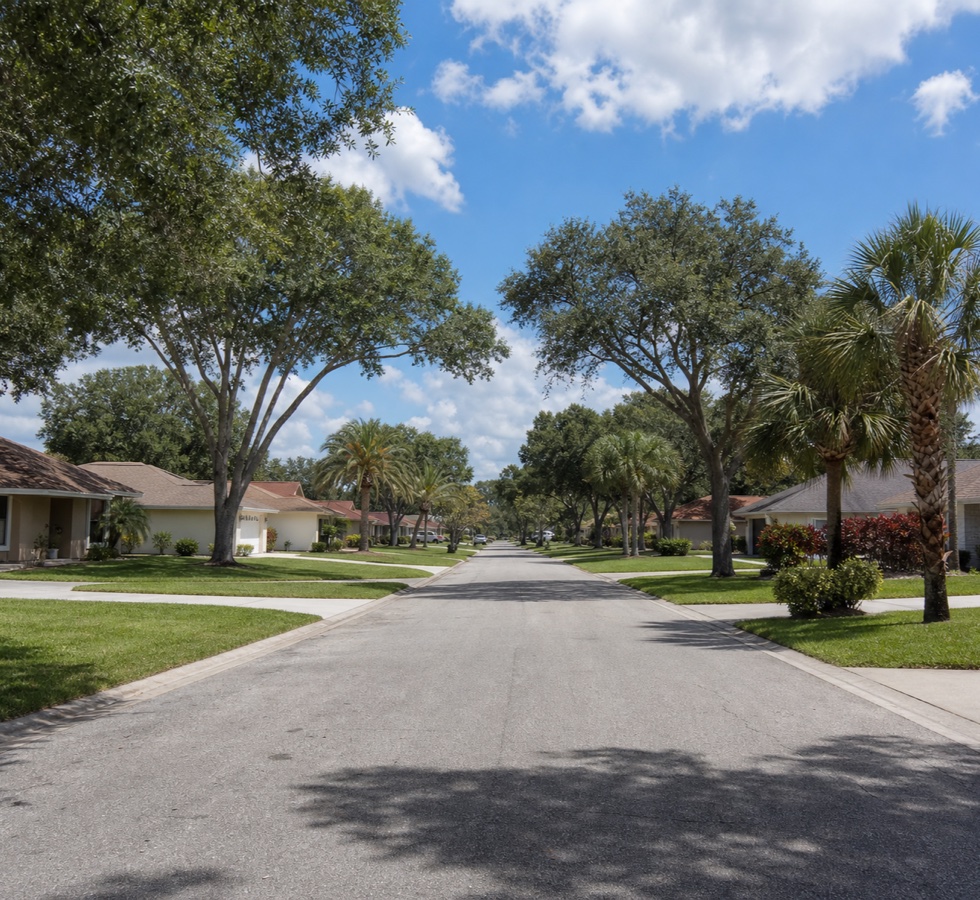
A quiet North Pinellas street of single story homes with live oaks, cabbage palms and well kept St. Augustine lawns.
02 Lifting low limbs

What lifting a tree means

Lifting is taking the lowest branches off so the bottom of the canopy sits higher than it did. Nothing about the top of the tree changes. What changes is how much room there is underneath it.

A live oak or a laurel oak left alone will hold branches out sideways at head height, and on a small lot those are the branches that end up over the driveway, across the walk to the front door, or in the way of the mower. Lifting takes those off at the trunk or at a main limb, so the tree keeps its shape and you get the ground back.

Clearance is worth thinking of as a height rather than as a feeling that the tree is in the way. General practice is to keep a walkway clear to roughly eight feet, which is above the height of anybody using it, and to keep a driveway clear to something nearer fourteen feet, because a pickup, a van, a boat on a trailer or a delivery truck all need more room than a car does. A limb that a sedan passes under all year is the one that takes the corner off a moving truck.

Lifting is done in stages over more than one year on a young tree. There is a limit to how much live foliage a tree can lose at once and still feed itself, and the general rule is to keep it to about a quarter of the live crown in a single year. A tree stripped bare up the trunk in one go loses more leaf than it can spare, and it answers with a rash of weak shoots along the trunk.
Clearance worked to

UnderneathClear to about
Walkway or sidewalk8 feet
Lawn you have to mow8 feet
Driveway14 feet
Street or curb line14 feet

These are the general figures used for street and yard trees, not a rule of the company. A young tree may not have the height to give you all of it yet, and in that case lifting is done over a few years instead of one.

03 Growth on the roof

Why growth has to come back off the roof

A branch resting on a roof looks like nothing at all from the yard. It is one of the few things in a yard that quietly damages the house.

It wears the shingles

A branch touching a roof does not sit still. Every breeze drags it across the same few shingles, and asphalt shingles give up their granules to that kind of rubbing. The bare patch it leaves is where the roof starts failing first.

It is a bridge onto the house

A limb reaching the roof is a road. Rats and squirrels use it to get to the soffit and the attic vents, and ants walk in along it as well. Taking the branch back off the roof line takes the bridge away, which is a great deal simpler than dealing with what came over it.

It fills the gutters

Anything overhanging the roof drops leaf litter straight into the gutter. A packed gutter holds water against the fascia through the wet season and sends the overflow down the wall instead of away from the house.

04 Before storm season

Why this is done before storm season rather than after it

Storm season runs from June 1 to November 30, and the daily afternoon storms run through the same months. A limb over the roof in June is a different problem from the same limb in March.

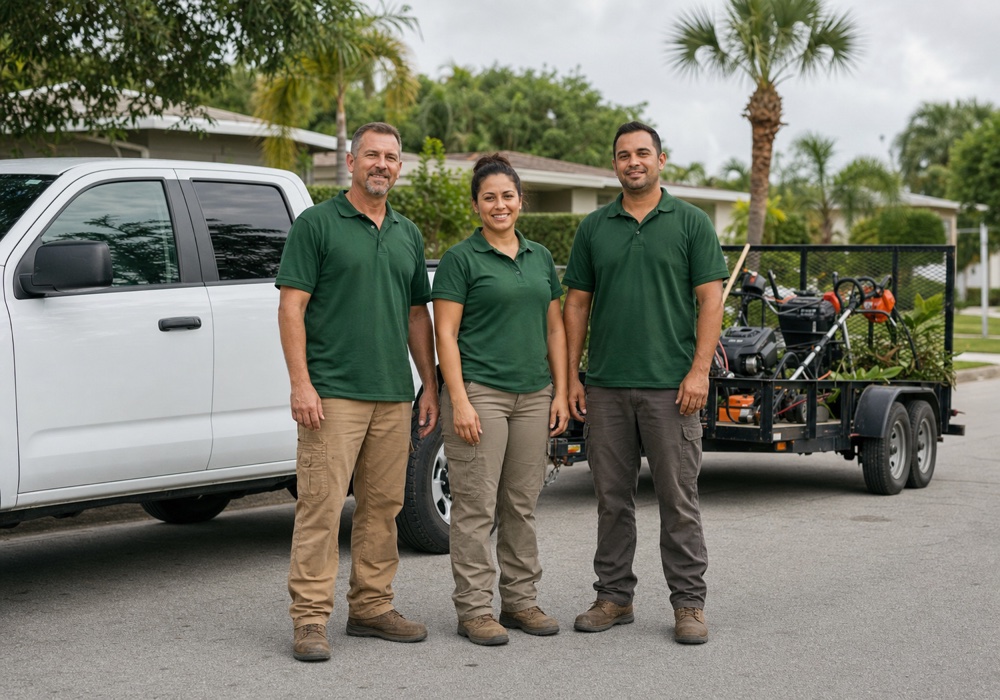
A lawn care crew standing in front of a pickup and equipment trailer.

In March a branch over the house is a job you get around to. In June the ground under the tree is saturated, the wind arrives in gusts rather than as a steady blow, and the branch is carrying its full weight of summer leaf. The same limb is now something you are watching from the window.

  • Dead and broken wood is what comes down first. It is also the easiest thing to take out ahead of time, and taking it out early is the single most useful thing anyone does to a tree before a storm.
  • Wet ground holds a tree less well. Sandy soil that has had rain on it every afternoon for six weeks gives up its grip on a root plate far sooner than dry ground does.
  • Work in the drier months is easier on the tree. Cuts made while a tree still has a long growing season in front of it seal over faster than cuts made late in the year.
  • Thinning a canopy too hard is not storm preparation. Stripping the inside of a limb out and leaving the foliage in a tuft at the end of it puts all the leverage at the tip, and those limbs break more readily in wind, not less. Clearance and dead wood are the useful work.
05 Related work

What usually gets booked with tree work

Tree work brings a lot down onto the beds and the lawn underneath, so these three tend to be part of the same conversation.

Free quotes

Tell us about the tree

Call us and describe the tree, or send us a message through the form. We will come out, look at it, and tell you what we would do to it and whether it is work we take on. There is no obligation once you have an answer.

Seven days a week, 9:00 AM to 5:00 PM. Email cjackc.inc@gmail.com.

Call now Free quote